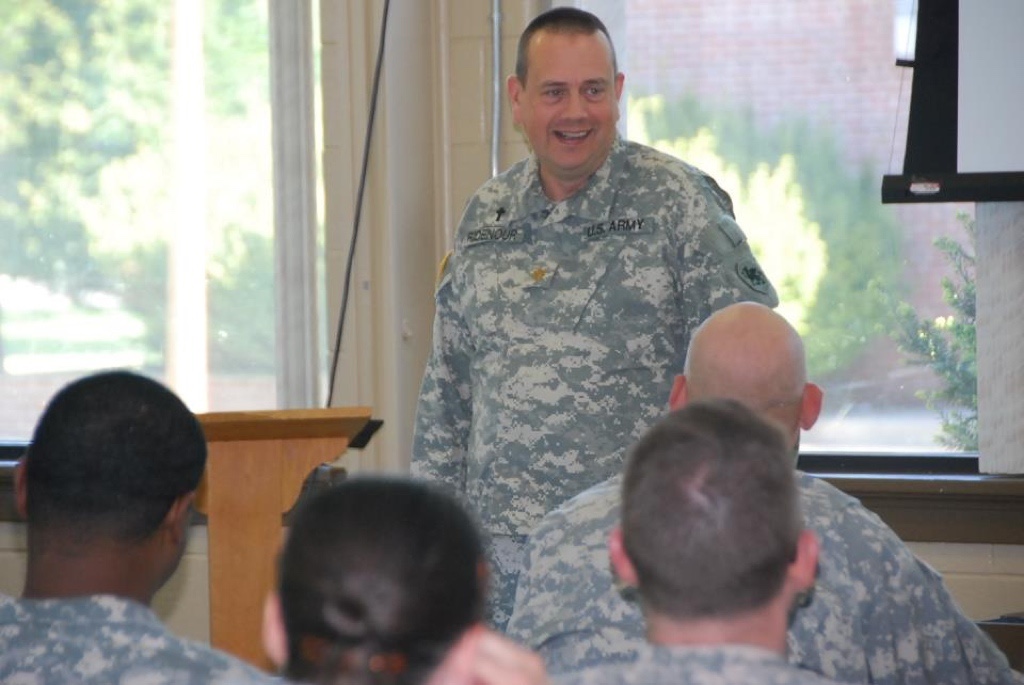
In this article, I interview Dr. Randy Ridenour about Military Chaplaincy. Ridenour is Professor of Philosophy at Oklahoma Baptist University, where he has taught for twenty years. In 2017, he retired from a thirty-four year career with the United States Army Reserve. As an enlisted solider, he served as an infantryman and as a chaplain’s assistant. In 2000, he was commissioned as a chaplain, and served three active duty tours at Ft. Hood, Iraq, and Afghanistan. He has been married to his wife, Sheri, for thirty-five years, and they have a daughter, Rachael, and a son-in-law, Josh.
Thank you to Dr. Ridenour for taking the time out of his schedule to answer these questions for us. My questions and comments appear in bold font, and his responses follow them.
What led you to join the military and then become a chaplain?
To be honest, I was attending the University of Oklahoma, but did not have any firm vocational plans, and thus no motivation for attending class. So, I decided to take some time off from school, and to do something else besides waste tuition money. The military seemed like a good choice, and the Army was offering the most in terms of enlistment bonuses and education money.
After nearly five years on active duty in the infantry, I went back to college to study philosophy. I joined the Army Reserve, primarily to earn some extra money while I was in school. I had always felt that I had been called to some kind of ministry, and two chaplains with whom I served helped me to discern that calling, and encouraged me to become a chaplain.
What is the primary job of a military chaplain?
Military chaplains have two roles. The first is to perform or provide religious services for members of the military, their families, and for authorized civilians. The second is to advise unit commanders on matters of ethics, unit morale, and ways that religion affects military operations. This means that chaplains need to be effective ministers, but also skilled counselors, with knowledge in ethics and world religions.
You are a Christian, and you served as a Baptist chaplain. What happened if you had someone come to you from a different Christian tradition or different religion?
Before I can answer that question, I need to explain how endorsement works in the chaplaincy. Chaplains are military officers, and, as such, must comply with the rules and standards that apply to all military officers. There are other requirements, though, that only apply to chaplains. Before one can be a chaplain, one must be endorsed by an authorized endorsing agency. This is usually an agency within the denomination to which the chaplain belongs. For example, the endorsing agency for the Southern Baptist Convention is the North American Mission Board. There are also special endorsing bodies for non-denominational chaplains. These bodies are needed to certify that the chaplain is a minister in good standing, according to the expectations of that denominational body. If the chaplain were to lose that endorsement, then the chaplain could no longer serve. This is important to understand, because endorsing bodies have rules that their chaplains must comply with, for example, an endorser can prohibit certain behaviors or forbid their chaplains from performing certain religious services. Each chaplain can only minister within the bounds determined by that chaplain’s endorser. The military will not force a chaplain to perform a kind of service that the endorser has prohibited.
Some other branches of the military operate differently, but Army chaplains are assigned to units that are battalion size and larger (a battalion can have up to 1,000 soldiers). Obviously, not all members of any unit that I was in were Christians. Whether I could meet a non-Christian soldier’s need, depended on the nature of that need and the requirements of my endorser. For example, if a Jewish soldier came to me expressing a desire for Jewish services on the High Holy Days, I could not perform those services. I am obligated, though, to ensure that the religious liberties of soldiers are protected. I am not obligated to meet the religious needs of all my soldiers, but I am obligated to ensure that their religious needs are met, which is a fine, but important, distinction. In this case, I would meet with the commander to make sure that the soldier had time off on Saturday to attend services led by a rabbi.
There were many times that I conducted counseling for non-Christian soldiers, because, as their unit chaplain, they had a relationship with me that made them more comfortable speaking to me than to a chaplain from their own faith-group.
What did the work of ministry look like in this context?
Ministry, in a religiously pluralistic environment, begins with building relationships. As tempting as it is to stay in the office all week, preparing for the sermon on Sunday, effective chaplains are out doing whatever their unit’s soldiers are required to do. For example, if soldiers are required to do unit physical training at 0600, then I would be out there with them. If the soldier were at a rifle qualification range, then I would be there. Chaplains are non-combatants, and neither carry nor fire weapons, but ranges gave me a good opportunity to chat with my soldiers as they waited for their turn to fire. The more time that I spent with soldiers during their routine, day-to-day activities, the more likely those soldiers were to come to me when they needed spiritual guidance.
Resources were stretched thin during my Afghanistan deployment, so my ministry had to expand. I was the Protestant chaplain for a NATO base, and I was responsible for all three of the Protestant Christian services on the base. The services differed mostly by worship style – a Gospel service on Saturday night, a liturgical service on Sunday morning, and a contemporary service on Sunday evening. On Fridays, the Roman Catholic chaplain and I would travel, by ground convoy and helicopter, to three other bases that did not have chaplains to perform services there. The rest of the week was spent in counseling, sermon preparation, and activities that enabled me to reach out to soldiers whom I probably wouldn’t see in chapel.
What did chaplaincy change about how you approach ministry in your local church?
That’s an interesting question. First, I began to understand the importance of relationships. Contemporary America is as religiously pluralistic as the Army is. That means that effective ministry cannot be confined to the four walls of the church building. Economic and employment realities may also mean that the worship needs of the entire community can’t be met at the traditional hour on Sunday morning. We spend too much time developing programs, and too little time developing relationships.
Second, I learned that effective ministry may not always be helping people myself, but getting people to the help they really need. I learned quickly in the Army that there are problems that I do not have the required skills to solve, and the best thing that I could do is to enable that person to find the help that they really need. Ministers need to be aware of, and not too proud to use, the caregiving resources of their communities.
Third, I have developed a greater admiration for liturgy. Military life is filled with constant change, and military congregations are always different from week to week as new people rotate in and others redeploy. On one Ash Wednesday, I had taken a Catholic priest out to a training area to perform a service for some National Guard troops. As I watched from the back, I noticed that these soldiers, who came from all different parts of the country, instantly formed a bond because of their common familiarity with the liturgy. Participation in the liturgy results in a natural feeling of community.
Finally, I developed an appreciation of the individual church as being part of something more than just a member of a particular denomination, but as part of the Church, holy and catholic. Working with colleagues who ranged from Pentecostals to Russian Orthodox transformed my suspicion of differences into an appreciation of diversity. This has also led me to always try to keep my primary focus on Kingdom growth, not simply local church growth.
What advice would you give someone considering becoming a military chaplain?
First, make sure that you are considering it for the right reasons. Military ministry has many advantages when compared to the local church: salaries are covered, the utility bills at the chapel are always paid, and the military provides everything necessary for conducting services. Chapel congregations use all of their offering money to support their ministry projects. So, that provides a kind of security that many pastors do not feel. Those are not sufficient reasons, however, to become a chaplain.
Second, be sure that you can minister in a pluralist environment. We must speak the truth, but we must do it in a way that is not degrading, demeaning, or belittling. If you cannot see yourself being able to give a Koran to a Muslim soldier, then military chaplaincy is not for you. Military chaplaincy requires a strong commitment to religious liberty for all, one of the traditional Baptist distinctives. Also, you will have to work with ministers of different denominations and even different faiths. Your ministry will always be within your own tradition, but that doesn’t mean that you won’t have to do administrative work with an Imam or Rabbi.
Third, and the most important practical advice, is to go to seminary. In order to be a chaplain, you must have a Master of Divinity or equivalent. There seems to have been a move away from traditional seminary education for many young ministers today. In the chaplaincy, however, that is not an option, you must have the education.
Finally, you must consider the cost, and the cost can be significant. There is the emotional cost: casualty notifications, memorials for soldiers killed in combat, and losing friends and comrades. Most importantly, be aware of the effect that it will have on your family. I was separated from my family for three of the years between 2003 and 2013. Those years were incredible ministry experiences, but they came at a great cost to my family. My wife was essentially a single parent during one of our daughter’s most difficult years. A week before my daughter’s wedding, it was still uncertain whether I would be able to get leave from Afghanistan. Fortunately, I was able to come home, but there was never any guarantee. Soldiers get medals and accolades, but military families are the unsung heroes.
The challenges may be great, but the rewards are even greater. It is a humbling experience to minister to members of the military, especially in combat environments. The things that we often do by rote, prayer, communion, etc., take on an urgency that is rarely felt. In this urgency, the reality of God is experienced in new and profound ways, both by the chaplain and those whom the chaplain serves.
Thank you again to Dr. Ridenour! Look for more interviews on chaplaincy and other topics in the near future! If you liked this interview, please like the post, share it with others, and check out my previous interviews and posts under the “Blog” tab.

 Chandler Warren