Counterintuitive Advice for Pastors

From the start of the summer, I have participated in a weekly online cohort for pastors. It has focused on areas of ministry faithfulness and fruitfulness that I don’t always think about or emphasize in my own ministry. If you’re interested in this cohort, you can find it here. My time in the cohort has led me to embrace some counterintuitive advice for pastors, some from the cohort and some from elsewhere, that really works.

In my experience, pastors often fall into one of two categories: workaholics or slackers. This article is for the former. Workaholic pastors can easily be misled—by themselves or by well-meaning church members—into believing their overwork is a sign of virtue. But if you’re in that camp, know this: you’re not just hurting yourself; you’re also doing harm to your church.

Do Less

God gave the church pastors “to equip the saints for the work of ministry” (Ephesians 4:12).

(If you want to learn more about this, you can watch a sermon that I preached on this passage: https://www.youtube.com/watch?v=91qdGfcVzoI.)

Your church members need to learn to do the work of ministry. As the pastor, it is your responsibility to train them. If you can equip the saints for the ministry, their combined impact for God’s kingdom will be greater than yours ever could be on its own. You just have to delegate, train, empower, and encourage them. For pastors, figure out what only you can do in the church and then delegate everything else that is on your plate. The church members need to do the ministry; you can’t horde it all. If someone can do the work even 80% as good as you think you can after a year of training and encouragement, they are talented enough to do it.

Be Gone More

You don’t want your church to be built on you. You can’t handle the weight of it. As they say, out of sight, out of mind. If you’re gone, the church has room to breathe and minister without you. This is healthy for you and the church. Go to your denomination’s annual meetings. Take a week for a pastor’s retreat. Do that mission trip overseas. Preach a revival at a sister church or a camp. Take all your vacation days and enjoy them with your family. People will call you lazy. People will say you only work one day a week. We know they’re wrong. You are doing your job when you’re gone because your job is to equip the saints for the work of the ministry. They are being equipped not only in your absence but by your absence.

Take Your Days Off

You are finite. You are mortal. You are limited. Take your days off. Aim for two every week. Weddings and funerals happen. They’ll take plenty of your days off. Get two on the weeks you can, and one on the weeks you can’t. If you plan for one, you’ll end up with zero. Your family will appreciate it. You will appreciate it. Your church will appreciate it because you’ll have something to talk about other than church. While I’m at it, make an appointment to get a full night’s sleep every night. Accept your limitations. Everything will go better when you do.

Preach Less

I hate this one. I love preaching. I rarely feel better than when I’m in the pulpit.

However, I can’t stay fresh in the pulpit if I never take breaks. When I preach around eight weeks or more in a row, I start feeling in the pulpit like Bilbo Baggins in The Fellowship of the Ring. He said, “I feel thin, sort of stretched, like butter scraped over too much bread.” That’s how I start to get in the pulpit without a break.

I need to hear someone else preach a few Sundays a year, and I need to see them in my pulpit. My church needs Sundays to be exposed to solid, guest preachers and for us to develop new ones. Just this month, I had a church member preach his first sermon on a Sunday morning. He did excellent! So, I don’t feel bad about taking those Sundays off even if I get the occasional church member who gives me a hard time about it.

Conclusion

When you’re in a rut or your church’s attendance has plateaued, how many people would tell you to do less, be gone more, take your days off, and preach less? Sadly, not enough. Normally, you get this kind of advice when you’re close to burning out, but I hope that you see this advice doesn’t just benefit you, it benefits your church. Your church needs you to do less, so they can take on the work God has called them to do. They need you to be gone more because your presence casts a large shadow, and your absence requires them to step-up. You need to take your days off because you won’t give your church your best when you give them everything. You need to preach less because they need to hear someone else, and they need you to preach out of a full heart not an empty one.

Spiritual Fatherhood

Yesterday was Father’s Day. At our church, we use Father’s Day and Mother’s Day to honor the godly men and women in our congregation. We honor all men and women because, even without biological or adopted children, every Christian can be a spiritual parent to someone else.

Most Christians that I regularly engage with are Protestants. They belong to a church affiliated with the Reformation or some post-Reformation denomination. Of those folks, most are theologically evangelicals. Therefore, most don’t like referring to ministers with the honorific of “Father.”

Roman Catholics often call their parish priests Father. Occasionally, I hear some Anglican friends do the same; some Orthodox traditions do this too. To these, I sometimes hear people cite the words of Jesus in Matthew 23:9, “And call no man your father on earth, for you have one Father, who is in heaven.”

Call No Man Father?

Without getting into a full essay on Matthew 23:9, we must understand three things: (1) the purpose of this pushback, (2) the inconsistent application of this critique, and (3) the larger biblical witness.

But you are not to be called rabbi, for you have one teacher, and you are all brothers. And call no man your father on earth, for you have one Father, who is in heaven. Neither be called instructors, for you have one instructor, the Christ. The greatest among you shall be your servant. Whoever exalts himself will be humbled, and whoever humbles himself will be exalted (Matthew 23:8-12).

Jesus pushes back on those who would elevate themselves with titles. The final verse says, “Whoever exalts himself will be humbled, and whoever humbles himself will be exalted.” The issue is with the scribes and Pharisees, the people Jesus was addressing (see 23:2), elevating themselves with titles like “rabbi,” “father,” and “instructors.” The issue wasn’t those particular words. The issue was the prideful hearts that those words represented. This does not mean that titles are unhelpful, but it does mean that people shouldn’t bestow titles on themselves. We can’t avoid these titles. Even outside the church, we have teachers and fathers. The heart was the issue, not necessarily the labels.

Furthermore, many Christians who would use Matthew 23:9 to push back against calling a priest/pastor “Father” would be fine calling some people in the church teacher. For example, they may call their pastor or Sunday School instructor “teacher.” Throughout Paul’s letters, we are faced with the reality that some are called to specific offices and thereby called to bear specific titles (see Ephesians 4, 1 Timothy 3, and Titus 1).

Finally, under the inspiration of the Holy Spirit, Paul calls himself a father in a spiritual sense. As far as we can tell, Paul had no children of his own. At the time of his gospel ministry, he was single and committed to singleness (1 Corinthians 7:8). To the Christians in Corinth, he wrote,”For though you have countless guides in Christ, you do not have many fathers. For I became your father in Christ Jesus through the gospel” (1 Corinthians 4:15 ). In the church traditions that I have been a part of, we often call fellow Christians “brothers-in-Christ” or “sisters-in-Christ.” Paul identifies himself here as serving the Corinthians as a “father-in-Christ.” They are not his biological children. They are not his adopted children. They are his spiritual children, in a sense.

Paul similarly calls Timothy his son and refers to himself as Timothy’s father. In Philippians 2:22, he writes, “But you know Timothy’s proven worth, how as a son with a father he has served with me in the gospel.” Again, Paul is not Timothy’s biological or adoptive father, but he identifies Timothy as a spiritual son and himself as a spiritual father, as they work together in the gospel ministry.

For these reasons, although we may not choose to call ministers or mentors “Father” as a title, we can acknowledge the deeper reality of spiritual fatherhood or, to put use more biblical language, “fatherhood-in-Christ.”

The Pastor as Father-in-Christ

Yes, every Christian man is our brother-in-Christ, but some men play a special role in mentoring, guiding, instructing, training, and disciplining others for the sake of following Christ well. Of course, pastors/elders can take this role. Those whom God has specifically called to the work of gospel ministry are particularly able to function as father figures.

The men who are called to “shepherd the flock of God that is among you” (1 Peter 5:2a) often serve as fathers-in-Christ to the congregation. They cannot minister in an unrestricted sense to the women of the church, but they can publicly teach, encourage, and pastor the women of the church. With proper accountability, they can provide great spiritual care for women. Even more so, they can pastor, lead, teach, love, and disciple the men of the congregation. In directly ministering to the men, they can indirectly minister to many women who are married to these godly men who are called to be husbands and fathers to their families.

Many people grow up with absent, estranged, or outright abusive fathers. They struggle to see the love and goodness of God because of this personal hang-up. Men are given the title of father, so that they can see that their fathering mirrors the fatherhood of God. Unfortunately, they fail and are sometimes unrepentant; instead of benefitting their children by following the example of our Heavenly Father, they project a poor image of fatherhood onto God. Pastors can play a key role in giving another person, an imperfect example of fatherhood which, while still fallible, better exemplifies God’s character and admits where he falls short and seeks forgiveness and change in the face of it.

Embracing Fatherhood-in-Christ

Every man, whether he has fathered biological or adopted children before, can be someone else’s father-in-Christ. They don’t need to be ordained or called to ministry to play this important role. Sometimes the simplest and most humble men play this role for myriads of men throughout their lives. They lead men to trust in Christ. They teach them how to follow him. They help them to abide in him. They send them out to do the same for others. All the while, they teach no adult Sunday School class, lead no men’s Bible study, and bear no title. They simply do what a father does for his children.

If you are a Christian man, I want to challenge you to seriously consider the opportunity before you. You can have a generational impact for Christ. You can change the trajectory of men and families for lifetimes simply by being like a dad for kids who aren’t your own. You may only have Jesus in common with them, but you can use that common union to advance a deeper relationship of encouragement, accountability, love, and discipline.

I’ve focused on the idea of a father-in-Christ, but I want to acknowledge the biblical reality of a mother-in-Christ (see Titus 2). We honor women for the spiritual mothering that they can provide in our lives. Because of this, if you are a Christian woman, you can also take on this challenge to provide the kind of mother some people have never had. Even if they have a great relationship with their mom, you can still provide a care for them that helps them to know Christ, trust Christ, follow Christ, abide in Christ, and share Christ with others. What a gift!

In Scripture, children are a blessing. For example, Psalm 127:3-5a says:

Behold, children are a heritage from the Lord,
    the fruit of the womb a reward.
Like arrows in the hand of a warrior
    are the children of one’s youth.
Blessed is the man
    who fills his quiver with them!

Even if God hasn’t blessed you with children in your home, he can bless you with children in your heart. He can bless you with brothers and sisters-in-Christ who also call you, even if just in their minds, father or mother.

How Tom Wright Changed My Life

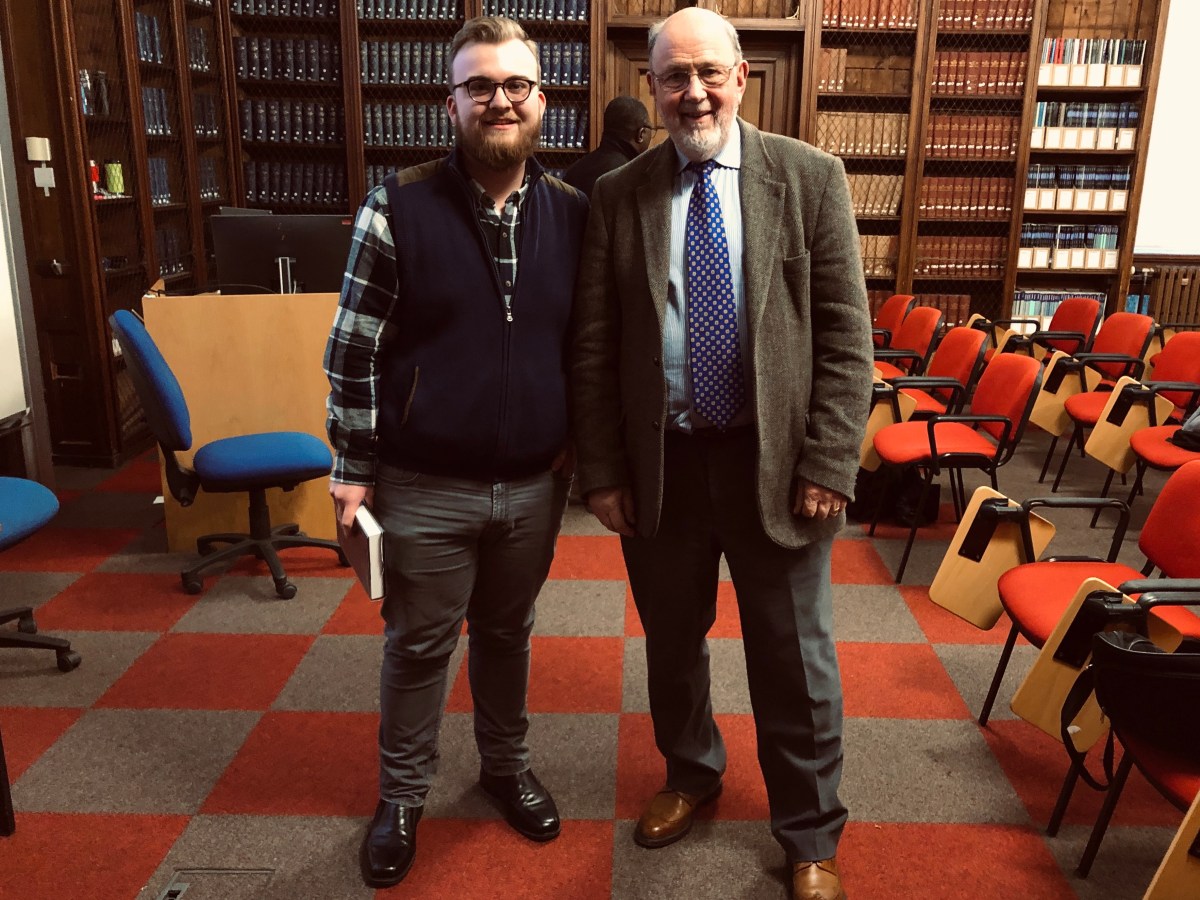
Yesterday (7 February 2020), St. Mary’s College of Divinity at St. Andrews had an event to honor and remember Tom Wright (a.k.a., N.T. Wright) for his tenure at the university. Professor Wright held a distinguished chair in New Testament for nearly a decade (a chair previously held by Richard Bauckham). As Professor Alan Torrance mentioned yesterday evening, he was responsible for millions of pounds being poured into St. Mary’s via student enrollment and grants. He was also instrumental in Logos (the program I study in) starting and being developed at St. Andrews. But I want to point out a few other ways that I have benefitted from his lifetime of scholarship.

When I was a high school student, I first heard the name N.T. Wright when my pastor and worship pastor wanted to take a group from the church to Oklahoma Christian University where he was speaking. The trip ended up being cancelled, and I didn’t get to go. (I would then meet him New Orleans some years later where he signed every book I had by him at the time, and then I would have classes with him some years after that.) Instead, I wouldn’t interact with Wright’s work for another couple years until I picked up the book Simply Christian and then Simply Jesus after that. Again, I wouldn’t interact with his work in any meaningful way until my undergraduate years.

The two primary things I learned from N.T. Wright which I should have known, but never did, were: the Jewishness of Jesus and the New Testament, and the Christian hope of future resurrection. I grew up in Christian communities that never spent much time thinking about how deeply Jewish Jesus was or the four gospel accounts which talk about him or Paul’s letters or any of it. Jesus is Jewish—not formerly or temporarily Jewish. Jesus continues to be Jewish, as does the New Testament. How are we to read the gospel accounts, Acts, Paul’s writings, the letter to the Hebrews, or the letters from Peter or John or Jude if not as profoundly Jewish texts? Yes, they often write to a wider audience—especially Paul’s letters, but they do so from a religious background and history of thought which is profoundly Jewish.

Finally, Tom Wright taught me the Christian hope. I always imagined death to be the end. I don’t mean that I thought we would just die and that there would be nothing. But I did imagine that we would die and go to heaven—some would go to hell—and that everything would just be disembodied and ethereal. However, in reading Wright’s works, I realized that the New Testament teaches something profoundly different. It teaches that God will raise us bodily from the dead in the end and bring heaven to earth. It teaches that if God doesn’t raise us like Jesus, then we ought to be the most pitied because we are wasting our lives. I can’t even recount the experience of reading The Resurrection of the Son of God for the first time. If I could get everyone to wade through its hundreds of pages, I would want every Christian to read it.

In summary, Tom Wright changed my life. His teaching impacted how my professors read the New Testament. In reading his work, I realized how profoundly he impacted my own professors. In reading his work, I realized essential truths of the Christian faith for the first time. In reading his work, I realized the Christian hope, and in reading his work, I realized that the story of Jesus is the climax of the story of Israel. I, like many, am forever indebted to the life and scholarship of N.T. Wright. May God bless him abundantly in his retirement (even if, it’s just “in name only”)!

Pastoral Theology with Matthew Halsted

In this article, I interview Dr. Matthew Halsted about pastoral theology. Halsted is the Senior Pastor of First Baptist Church of McLoud, OK and a lecturer at Oklahoma Baptist University. His academic research has focused on biblical hermeneutics (i.e., interpretation) and the New Testament’s use of the Old Testament especially in Paul’s letters. He is the founder and director of Trinityhaus (a center for Christian thought). He has presented papers and given talks nationally and internationally, and he is passionate about bringing academia into conversation with the local church.

Thank you to Dr. Halsted for taking the time out of his schedule to answer these questions for us. My questions and comments appear in bold font, and his responses follow them.

What is pastoral theology? And what interests you about pastoral theology?

Broadly speaking, “pastoral theology” can be defined as fleshing out theological truths within the context of Christian ministry—particularly at the local church level. It is, by definition, applying God’s unchanging truth to the ever-changing circumstances of the lives of a worshiping congregation.

I suppose what interests me most about pastoral theology is that it requires attentiveness to both the needs of the congregation and to the biblical text. This relationship between Scripture and congregation is fascinating to me. Pastors must remain faithful to the Bible as God’s Word and, at the same time, be creative in how the truth of the Bible is fleshed out into the life of the congregation. This relationship between the truth of the fixed text and its fresh application to the contingencies of parish ministry is the heart and soul of pastoral theology.

Because pastoral theology covers several different topics, I would like to give you space to share your thoughts on a few different ones. How about we start with the office of pastor? Do you think pastors have a special kind of authority? Why or why not?

That’s a good question. There is a sense in which pastors should recognize that their position is one of “authority.” It has to be remembered, though, that it is a derived authority. That is, pastors are not ultimately in charge of, or responsible for, the church (thank God!). Rather, a pastor’s authority is authoritative in so far as it is connected to the truths of Scripture. My Protestantism may be getting the best of me here, but under no circumstances is a pastor to be considered authoritative unless that pastor is operating within the boundaries of biblical, orthodox truth—which has been handed down through the ages.

I have to add one more thing, if I may. Our culture is obsessed with “authority” and “being in charge.” I immediately think of the situation in Mark 10. In that chapter, James and John requested positions of power and glory in the kingdom, but our Lord admonished them to be cautious. The pagan leaders, Jesus said, were too fixated on how they could “exercise authority” over people (v.42). This is not to be the way of Christ followers. Because I think Jesus remains the best mentor for pastors, I think his own model is worth following: Instead of being preoccupied with notions of power and authority, people would do well to become servants. Pastors ought to be the first servants of the church—if they desire to be faithful followers of their crucified Lord.

Prayer seems vital to pastoral ministry. How does your theology of prayer shape your ministry? And how do you teach your congregation to pray?

There is a huge temptation for pastors to reduce their entire ministry down to nothing more than “talking about God.” In many ways, this temptation is always present because—to state the obvious—the pastoral vocation seems to be about doing just that: talking about God. As pastors, we are expected to preach about God, teach about God, and talk about God. To make matters worse, we are expected to teach others to do the same! But if were are not careful, we will make God into an object to be analyzed instead of the One with whom we are to commune. Prayer helps us in this regard.

Indeed, prayer is communion with God. Of course, this involves making requests, lavishing praise, raising doubts, and confessing sin. But these things are not what prayer is; prayer is communion. If we are truly communing with God, then of course we will be doing these things.

Eugene Peterson made a statement once that prayer is not so much about being nice before God but rather about being honest with him. I also agree with Peterson that, if Christians want to develop a prayer life, the Psalter is necessary curriculum. It is indispensable.

Do you think prayer changes how God acts, and if so, in what ways?

I recall reading C.S. Lewis on this very question. His musings, as always, are helpful as we navigate this topic. Following Lewis, I think the ideal prayer request is a request for something good. But if God is good, then surely God would already want the good for which we are praying—independently of our praying or not praying. And if God is powerful, then surely he would be capable in his own strength to bring it about—again, independently of our praying or not praying. So, why pray?

I’ll be the first to admit that prayer is a mystery in this regard. But I think something along the following lines is true. First, because prayer is fundamentally about communion with God (as C.S. Lewis also observes, as I recall), then it only makes sense that God would want to involve his creatures—the objects of his love—to engage him in communal acts such as prayer. Second, if a relationship such as this is to be meaningful in any sense, then a person must be capable of making choices that are significantly free. This leaves open the possibility for God’s people to pray or not pray. And if prayer is to be one of these significantly free acts, it must be—in some way or another—effectual.

What this means is that some things will not happen if we don’t pray. In other words, some prayers are acts that bring about change that, all things being equal, would not have been brought about except through prayer. This seems to be what is meant by certain passages of Scripture such as James 4:2 (“you do not have because you do not ask”). Here, something is not happening because of the lack of prayer.

It is reasonable to suppose that God, in his sovereignty, has set up this world such that his creatures have this sort of significant freedom. This does not imply, of course, that everything depends upon our prayers or that God’s overall plan is itself dependent upon our praying. I have certain metaphysical commitments that permit me to think God, as the Absolute Good, will always get his way no matter what his free creatures choose to do or choose not to do—a subject for another day!

To change the topic a bit, John Calvin argued that a rightly ordered church includes the Word and Sacraments. What are these two different things? And could you explain your approach to both?

I think Calvin is largely correct here. The Protestant emphasis on the preaching of the Word is absolutely important to maintain. It is God’s Word, for example, that brings forth faith; it is God’s Word which instructs, guides, and corrects the church. So the proclamation of the Word, if it is not central, will result in a church that is not rightly ordered. The same can be said of the Sacraments—that is, the Eucharist and Baptism. The Eucharist, mysteriously, functions in the life of the church as a gracious benefit. It is a reminder of God’s goodness—one that is loving and confrontational all at the same time. Baptism, too, is inherently confrontational. It is an initiatory rite into a Kingdom that is opposed to this world’s powers. Like the proclamation of the Word, if the Sacraments are not properly placed within the life of the church, then our witness to the world will go impeded.

For pastors young and old, how would you encourage them to develop their pastoral theology? What resources or biblical passages would you direct them towards? What mistakes would you encourage them to avoid?

Every pastor needs to be a praying pastor. It’s essential. Prayer serves as a reminder that we are insufficient to bring about the Kingdom of God. I think one mistake pastors make is to treat their ministry as if everything depends on them. As a result of this mindset, pastors get emotionally discouraged and burned out. The truth, however, is that the success of the church depends on God, not us. All we are required to do is be faithful to do what he has given us to do, and he will take care of the results.

Again, I think the Psalms are super important for pastors. The main reason is because they will teach us to pray. I also think becoming familiar with the prophets, particularly Jeremiah, would be good for modern pastors. I have found the prophets to be encouraging friends and colleagues. In terms of other resources, I highly recommended Eugene Peterson’s works. His insights are gold.

Thank you again to Dr. Halsted! Look for more interviews with Matthew Halsted and others in the near future! If you missed my interview with Tawa Anderson on “Christian Apologetics” or my interview with Timothy and Faith Pawl on “Mary, the Mother of God”, you can view them here: Christian Apologetics and Mary, the Mother of God.

Encounters of Kindness

I grew up like many others reading picture books that wanted to teach us about kindness. I’ve even heard some in the church bemoan these books because it teaches people to be moral without teaching them about Jesus (the ultimate exemplar of virtue/morality), and it teaches them to care more about kindness than conviction. I’m less concerned about those particular issues when it comes to children’s books in public schools and doctors’ waiting rooms. However, I find it funny that with all these books and lessons that I have grown up with how unkind people can still be. It only takes a few minutes scrolling through social media or flipping through channels on television to learn that lesson. But despite this lack of kindness, there is actually so much around us. In this post, I want to share a point made to me about kindness and a couple experiences that I have recently had.

1. Can you do anything for Christ in an un-Christ-like way?

Without much information and perhaps as an act of faith, I trusted the advice of two people I barely knew (I met one in London and the other in Cambridge), and I reached out to a stranger living in St. Andrews. He welcomed me to his home, shared a pot of tea with me, invited me to stay for dinner with his family, and gave me some great advice and encouragement. I don’t want to rush to judgement, but he was possibly one of the wisest people that I have ever met.

While I met with him, he emphasized kindness as an important virtue for Christians to have. (This was unsurprising because of how well he was treating me.) He had just returned to town after teaching a week-long ethics course at a seminary. There he posed this question to his students, “Can you do anything for Christ in an un-Christ-like way?” It’s a question that hits you like a ton of bricks as you realize how un-Christ-like you have been in many situations where you once felt justified. It’s a question that demands only one answer, “No!” The ends do not justify the means. Jesus approached people with love—even his enemies. We are without excuse.

This question has been on my mind ever since.

2. A Cup of Tea, a Kind Concern, and the Power of Love

With this question deeply on my mind, I got sick. It was a week or so after that meeting (this last Saturday), and I woke-up with a sore throat. I was distracted all day with a day trip to Loch Tay, but that evening it returned. Sunday was rough again. Monday was dreadful. I barely made it through class. Tuesday was better, but when I arrived for class in the afternoon, one of the other students had brought me a green tea with ginger and honey from the shop he was studying in before class. (He commented that the person making the drink really wanted to add whisky to it.) It was one thing that he remembered that I wasn’t feeling well; it showed how thoughtful he was. It was an entirely other thing that he was also kind enough to do something for me. He didn’t just pray, which would have been enough, but he went beyond what was hoped, expected, or encouraged of him.

I have also had an instructor take special care to help me intellectually and pastorally with some of the content covered in class. He has taken the time to meet with me to discuss the content covered, and he has stayed after class and during breaks to ask me about the questions that I brought-up during the class time. He has not only been kind enough to meet with me, but he has also taken the initiative to reach out to me. Again, it’s been a time of seeing people be intentionally kind and loving to me.

I can’t think of anything greater, or more meaningful, than experiencing God’s love, and it can be difficult sometimes to have those experiences. But God has chosen to work through the church, through a community of Jesus-people. When we join in fellowship and discipleship with the Jesus-people around us, we can quickly and joyfully find the love of God waiting for us.