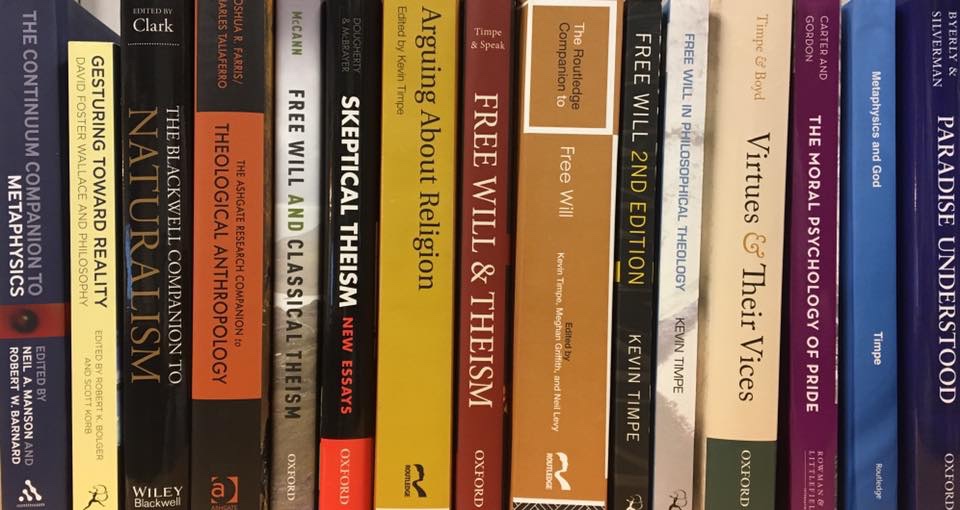
In this interview, I ask Kevin Timpe about free will. This is only part one of my interview with Dr. Timpe which serves as an introduction to the topic. In the second interview, Dr. Timpe will answer questions about free will and Christian theology.
Kevin Timpe currently holds the William H. Jellema Chair in Christian Philosophy at Calvin University. He’s written and edited a number of books on free will and philosophy of religion. In recent years, he’s turned much of his scholarly attention to issues in the philosophy of disability, intending to finish a book tentatively entitled Disabled Agency. He drinks more coffee than he should but less than he’d like. He, his spouse, and their three children live in Grand Rapids, MI where they sublet a house from three cats. It is rumored that he’s not as much of a curmudgeon as he appears to be on Facebook.
Thank you to Dr. Timpe for taking the time out of his schedule to answer these questions for us. My questions and comments appear in bold font, and his responses follow them.
What does “free will” mean?
Well, that depends on who is using the term. Peter van Inwagen, for instance, means ‘the ability to do otherwise.’ He says as much, for instance, when he asserts that “to be able to have acted otherwise is to have free will.” But not everyone means that same thing. I used to be more optimistic that philosophical phrases like “free will” had one meaning, but I’ve come to think that’s not the case in many instances. It’s really important for us to be clear which meaning we have in mind when we use such terms because if we don’t we can fail to notice that our claims may not be tracking with our interlocutor’s meanings.
Lots of the ‘folk’, as they’re sometimes called, seem to mean something like “non-coerced” when they use free will. But there are plausibly things we do that aren’t coerced that nevertheless may not raise to the level of free will. And, though this is contentious, I think that it’s possible to be coerced and have one’s free will remain intact. Some coercion just drastically shifts one’s incentives rather than removes moral agency. So depending on the context and what use we want to put the concept of free will too, I think the term can pick out different concepts such that there’s not just one thing that ‘free will’ means.
What are the primary ways of understanding free will?
As indicated above, there are some folks who hold that ‘free will’ means having the ability to do or act otherwise, and so they understand free will to be or centrally involve what I refer to as a ‘leeway approach’ to free will. But others understand free will not as always requiring alternative possibilities but rather as the kind of control over one’s actions—that is, being the source of one’s actions—in the way required to be morally responsible for their actions. This is what I refer to as a ‘sourcehood approach’ to free will.
It’s quite natural for lots of people to associate leeway approaches with libertarian views of free will, but I think that’s a mistake. There are a number of compatibilist views of free will that include the ability to do otherwise. And some libertarians—myself included—think that free will doesn’t always require leeway. I think that free will often involves leeway and sometimes requires leeway, but that’s because I think that satisfying the sourcehood condition on free will entails that the agent at least sometimes has the ability to do otherwise.
How does one go about deciding which way is right?
Well, I don’t think we decide contentious metaphysical issues simply by looking at what the dictionary says. And I’m less optimistic that we can come to ‘knock-down, drag-out’ winners than I used to be. Philosophy’s not like an epic match between Ricky the Dragon Steamboat and the Macho Man. I think that in many cases, we have to begin by thinking about what we want something like free will to do. Our concepts are deployed for purposes, and those purposes help shape what counts as an appropriate concept to use. I think that much philosophical work isn’t clearly won by a decisive argument, but by weighing the competing benefits and costs of various positions and trying to come to an overall ranking of which we think is best overall. But in doing so, various folks will both evaluate the options different and weigh them differently. Hence we get disagreement and, sometimes, what John Fischer calls ‘dialectical stalemates’.
That said, that’s at best an argument for incompatibilism (which is the view that our having free will is incompatible with the truth of determinism), which is weaker than libertarianism (which is the conjunction of incompatibilism and the affirmation of the existence of free will). I think the best way to try to show that free will does exist is to show that it’s required for something (e.g., moral responsibility) that itself exists.
What do you think is the most persuasive argument for libertarian free will?
I think that a version of what Peter van Inwagen has called the Consequence Argument is sound. As he originally formulated it in An Essay on Free Will, I don’t think it was. That formulation requires a transfer of powerless principle which he calls Beta:
If nobody has, or ever had, control about whether p is true, and no one has, or ever had, control over the truth of p entailing the truth of q, then no one has, or ever had, control over the truth of q.
Van Inwagen’s Consequence Argument can thus be summarized as follows (taken from his Essay on Free Will, 56):
If determinism is true, then our acts are the consequences of the laws of nature and events in the remote past. But it is not up to us what went on before we were born, and neither is it up to us what the laws of nature are. Therefore, the consequences of these things (including our present acts) are not up to us.
The transfer principle Beta is what justifies the conclusion on the basis of the two earlier claims.
But folks have since shown that Beta is invalid as an inference rule. There’s been a number of folks that have tried to show that other transfer principles can underwrite the Consequence Argument and are not invalid in the same way that Beta is. Joe Campbell has shown that the argument perhaps doesn’t show that free will and determinism are logically incompatible per se (claims of incompatibility are equivalent to necessity claims), since the argument requires a contingent proposition such as “there is a distant past.” But I think that one can show that in a world like we have reason to believe we inhabit, that if determinism were true then we wouldn’t have free will.
What do you think is the most persuasive argument for compatibilist free will?
I think that unless we have good arguments for the incompatibility of free will and determinism, we ought to think that they’re compatible—that is, we ought to be compatibilists about free will. Logical space is big, so to speak, and compatibilism just requires that there is at least some place where there’s free will and determinism is true. Claims of incompatibility, on the other hand, are stronger since they make claims that range over the entirety of logical space—there is no place where there’s free will and determinism is true.
Since I think there are good arguments for incompatibilism, you can infer that I don’t think there are persuasive (well, not persuasive to me) arguments for compatibilism. But other smart people disagree. Truth is often hard to achieve. The two authors whose work is most compelling to me in luring me toward compatibilism are Manuel Vargas and Jesse Couenhoven. Both of their books (Building Better Beings and Stricken By Sin, respectively) are excellent and challenging.
What are some practical implications to how one understands free will?
I think that what we think about free will matters for issues of responsibility—which is itself a complex cluster involving normative issues related to praise and blame, metaphysical issues such as causation and causal powers, legal and political issues, etc…. There are also a lot of clear implications for how we think about religious topics (e.g., heaven, hell). I think that free will is also closely connected with character formation, which in turn means that it has implications for what it means to be a good person (and what it means to be a good parent).
What resources would you recommend for people interested in this discussion?
Well, I think that almost everything in my own Free Will: Sourcehood and Its Alternatives (2nd edition) is true. But there are really quite a few really good books out there that can serve as introductions to the (immensely voluminous) philosophical literature on free will. Meghan Griffith’s Free Will: The Basics is a great lead-in to the literature, as is Joe Campbell’s book simply entitled Free Will. (I’m starting to think that some of us working in the field need to get more creative with our titles!) For many advanced work, Free Will: Four Views brings together four of the most influential current scholars defending positions that they are rightly well-known for: Derk Pereboom, John Fischer, Bob Kane, and Manuel Vargas. Lots of folks seem to have the idea that “science has proven that there’s no such thing as free will,” in part because a number of scientists claim this. Al Mele’s work Free: Why Science Hasn’t Disproved Free Will is the go-to source here.
And while this may seem self-serving (I mean, I think it is self-serving, but I don’t say it because it is), the Routledge Companion to Free Will that I co-edited with Meghan Griffith and Neil Levy a few years back is 700+ pages of breadth, historical depth, and contemporary overview on free will.
Thank you again to Dr. Timpe! Look for Part 2 of this interview with Kevin Timpe when he tackles questions of free will and Christian theology! If you liked this interview, please like the post, share it with others, and check out my previous interviews and posts under the “Blog” tab.
 Chandler Warren